Skip to content
Fazeshift announces strategic investment from Amex VenturesRead the announcement
  • Guide
  • Finance

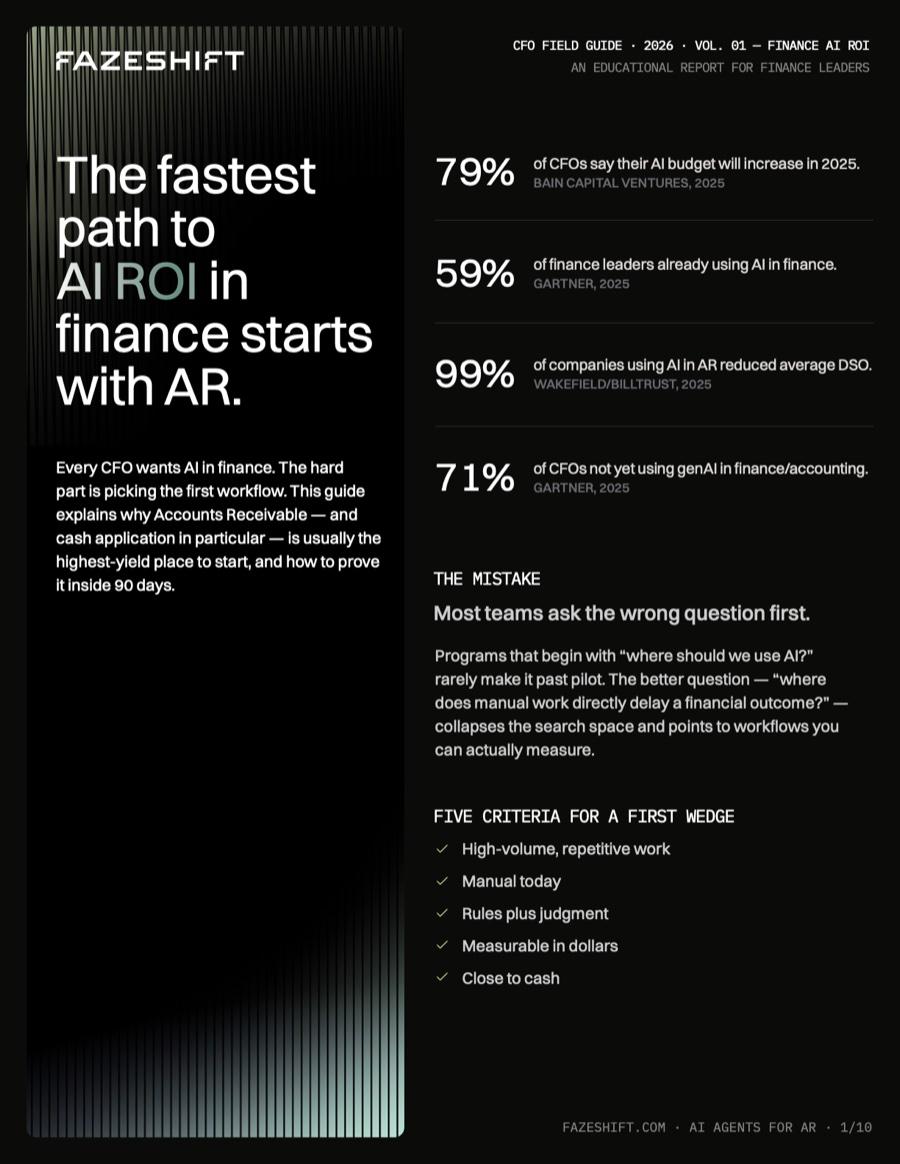
The fastest path to AI ROI in finance starts with AR

Every CFO wants AI in finance. The hard part is picking the first workflow. This guide explains why accounts receivable, and cash application in particular, is usually the highest-yield place to start, and how to prove it inside 90 days.

This guide includes:

Programs that begin with “where should we use AI?” rarely make it past pilot. The better question is “where does manual work directly delay a financial outcome?” This field guide uses it to narrow the search to a workflow you can actually measure.

  • The AI ROI scorecard for finance: FP&A forecasting, procurement, AP automation, month-end close, tax and compliance, and AR with cash application, compared on manual volume, measurable ROI, deployment speed, risk, and AI fit.
  • A worksheet to score your own candidate workflows on the five criteria: volume, manual work today, judgment versus rules, measurable in dollars, and close to cash.
  • Why AR comes before FP&A or AP: the “close to cash” principle.
  • A 90-day plan: diagnose and set the baseline (days 1–15), automate one workflow end to end (days 16–45), then expand (days 46–90).
  • A customer story from the field, and proof points on what good looks like.

Key findings

  • Start with the right question. Instead of “where should we use AI?”, ask “where does manual work directly delay a financial outcome?” That narrows the search to workflows you can measure.
  • Five criteria pick the first workflow: high-volume, repetitive work; manual today; rules plus judgment; measurable in dollars; and close to cash.
  • AR with cash application clears all five. Compared with FP&A forecasting, procurement, AP automation, month-end close and tax, it has the most manual volume, the most measurable ROI and the lowest risk, and the work (inboxes, PDFs, remittance, short pays, disputes) is messy enough to need agents rather than macros.
  • FP&A AI can be transformative, but its ROI is indirect: the win shows up in next quarter’s plan. AP is valuable, but most teams already have invoice capture and approvals in place, so the next AI dollar buys less.
  • The closer a workflow is to cash, the faster the ROI shows up. Cash application is where cash received becomes cash usable; when it lags, collections, aging and the forecast all run on stale data.

The 90-day plan, in three phases

  1. Diagnose (days 1–15): set the baseline before changing anything. If you can’t measure it now, you can’t prove ROI later.
  2. Automate one workflow (days 16–45): pick one narrow surface and automate it end to end, then check the baseline metrics before touching a second.
  3. Expand (days 46–90): layer adjacent agents onto the same data, and build the reporting dashboards last.

The bar for AI in finance

AI in finance touches customer communications and the financials themselves, so every action has to be auditable and recoverable in a system of record, with an error rate low enough to trust. The guide includes a customer story: a national IT staffing company with a $200 million backlog of unapplied cash, one of three deployments documented in Harvard Business School’s 2026 case study on Fazeshift.

Who this is for

  • CFOs deciding where the first AI budget in finance should go.
  • Finance leaders asked to show AI ROI within the year.
  • Teams whose AI pilots stalled because they started too broad.

Share

See it run in your system

Bring a batch of your real AR (invoices, payments, whatever’s messiest) and we’ll show you exactly how the agents would read, match, and post it back against your own records.

90–95% of cash application automated: the range customers typically see.

Book a demo