Skip to content
Fazeshift announces strategic investment from Amex VenturesRead the announcement
  • Report
  • Accounts receivable

The Collections Benchmark: what actually gets customers to respond

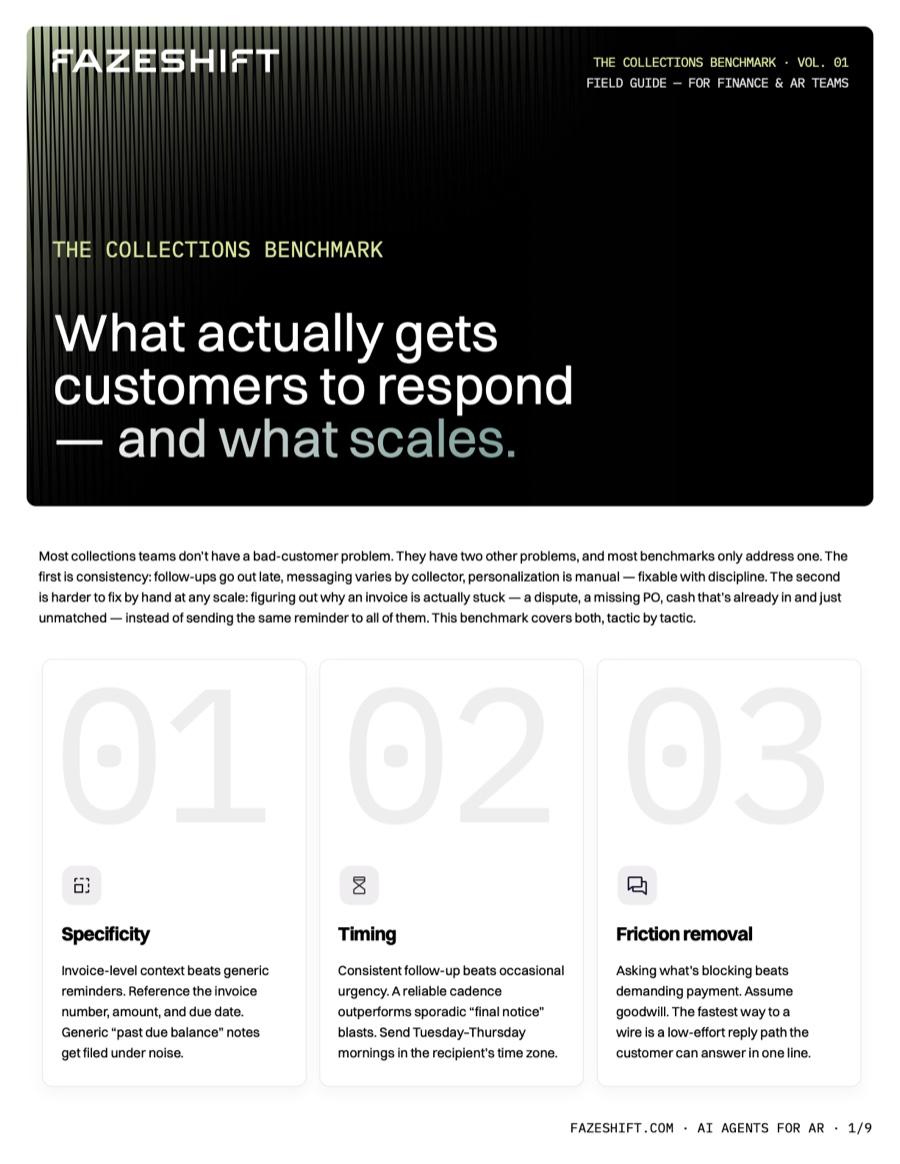
Most collections teams don’t have a bad-customer problem. They have two others: follow-up that isn’t consistent, and not knowing why an invoice is actually stuck. This benchmark covers both, tactic by tactic.

This report includes:

Consistency is fixable with discipline: follow-ups that go out late, messaging that varies by collector, personalization done by hand. Working out why each invoice is stuck, whether it is a dispute, a missing PO, or cash that already arrived and was never matched, is harder to do by hand at any scale. This field guide for finance and AR teams takes both in turn.

  • Subject lines: why neutral beats aggressive and specific beats vague, with lower- and higher-performing examples side by side.
  • Personalization: a structured template that pulls the invoice number, amount, due date, customer name, last touch, and known blocker automatically.
  • Timing: a baseline cadence that starts before the due date and beats occasional urgency.
  • Message anatomy: the four things every high-performing collections email does, in under 40 words.
  • A customer story on when the ERP’s own collections tool becomes the bottleneck, and third-party data on the gap.
  • A seven-question scorecard to run as a team.

Key findings

  • Subject lines: neutral beats aggressive, and specific beats vague. “Quick check on invoice 12345” or “Anything blocking invoice 12345?” outperforms “Final notice” or “Payment required”, because a question invites a reply. In one Fazeshift deployment using this register, 13,042 automated collection emails saw a 50% open rate and a 17% reply rate.
  • Personalization: personalized outreach drew 60% higher response rates than generic reminders in Fazeshift comparison data. It only scales when the details are pulled in automatically, not typed from memory.
  • Timing: a predictable cadence that starts before the due date beats occasional urgency. At one national wholesale distributor, an always-on cadence cut average days-to-pay from 72 to 17.
  • Message anatomy: high-performing collections emails do four things in under 40 words, starting with naming the invoice and assuming friction rather than bad intent.

When the ERP’s own collections tool becomes the bottleneck

A $350 million B2B services company on NetSuite received lump sums covering 100 or more invoices at once, and the built-in dunning module sent the same reminder to everyone. After moving to Fazeshift’s configurable cadence and cash application built for multi-invoice lump sums, DSO went from 120 days to 16 in five months while the AR base grew about 25%. Cash application effort dropped from 1.2 FTE to 0.2.

Industry context

  • The average company’s DSO was 40.12 days against a best-possible DSO of 31.59, an 8.5-day gap (Credit Research Foundation, National Summary of Domestic Trade Receivables, Q1 2026).
  • 75.7% of accounting processes remain largely manual, even as automation adoption accelerates (Trade Credit & Liquidity Management, David Schmidt, 2026).

Who this is for

  • AR and collections managers whose follow-ups go out late or vary by collector.
  • Controllers who want collections to start from why an invoice is unpaid.
  • Finance teams deciding which parts of collections to automate.

Share

See it run in your system

Bring a batch of your real AR (invoices, payments, whatever’s messiest) and we’ll show you exactly how the agents would read, match, and post it back against your own records.

90–95% of cash application automated: the range customers typically see.

Book a demo